Appendix B — SKCMDb: Slovak Comprehensive Music Database
The Slovak Comprehensive Music Database (SKCMDb) is a national initiative aimed at making Slovak music more accessible, discoverable, and usable across libraries, archives, streaming services, and rights management organisations. It connects scores, recordings, and metadata using open standards and collaborative governance. As a functional module of the Open Music Observatory, the SKCMDb also serves as a testbed for developing shared data services, addressing the conceptual models, workflows, and governance rules required to link diverse music stakeholders.
`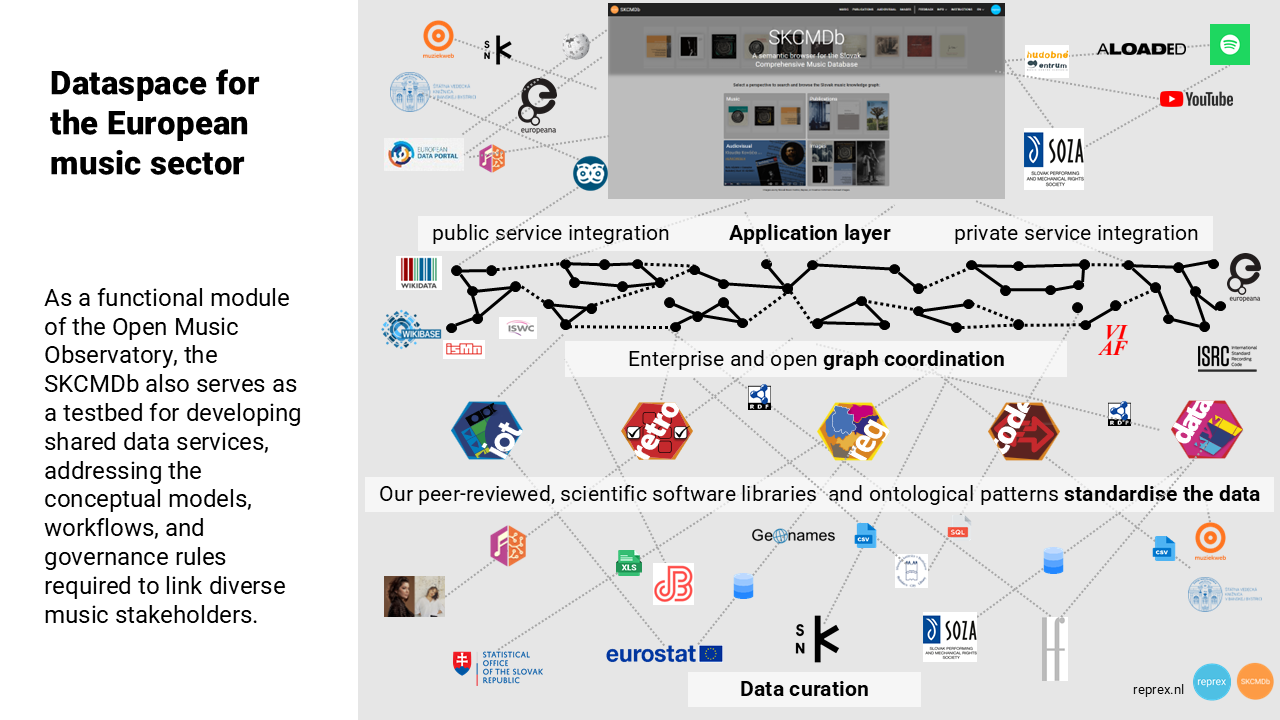
The SKCMDb is supported by a data-sharing space consisting of both shared and private databases.
The data-sharing space currently comprises the following initial components:
Slovak Metadata Database: A database that facilitates connections between various Slovak stakeholders’ systems.
SKCMDb(public): A public database containing microdata on musical works, their recordings and scores, biographical and institutional information, statistical datasets, and a catalogue of publications.SKCMDbHC-SOZA (private): A database used exclusively for rights management and library management, governed by an agreement between the Slovak Music Centre and SOZA.SKCMDbHF (private): A technical dataset created to provide improvements, corrections, and enrichments for the Hudobný fond.
The Slovak Metadata Database serves as a support layer that is partly public and partly private. Its metadata definitions and descriptive metadata are exported into the SKCMDb databases as needed and permitted.
The Slovak Metadata Database
The Slovak Metadata Database is developed in alignment with the metadata framework of the Open Music Observatory.
Ontological and thesauri patterns: Reuses standardized or widely adopted vocabularies.
Conceptualizations and definitions: Includes concept definitions, thesauri, and other elements developed specifically for the
SKCMDb.Public permanent identifiers: Uses identifiers that are public or can be made public.
The metadata layer is generally licensed under CC0, though in some cases other licenses are used (for example, CC-BY).
Examples:
The definitions of musical work, printed sheet music, and the is score of relationship allow the description of connections between an abstract musical work—such as Bella’s Missa in C—and its actual printed manifestations.
The VIAF identifier
2737220identifies Ján Levoslav Bella’s compositions across library systems.
Slovak Comprehensive Music Database (public)
The Slovak Comprehensive Music Database is a linked open database published by the Slovak Music Centre. It integrates elements from the Hudobné centrum’s own databases along with data made public by SOZA, Hudobný fond, and other organizations. The database is distributed under various Creative Commons licenses that allow both commercial and non-profit use.
The primary aim of the SKCMDb is to reduce the cost of maintaining public and private services that enhance the circulation, availability, visibility, and legally licensed use of Slovak music. Our licensing policies are designed to enable the widest possible use of the data while protecting the investments required to maintain registers, standards, and data integrity.
Slovak Comprehensive Music Database (private)
The private components of the SKCMDb consist of databases where the data is not intended for public sharing but is used to enhance rights management, music information services, library operations, or other specialized applications. These databases are maintained under agreements between the participating parties.
Access to these private datasets serves specific, well-defined purposes and is governed by strict rules. Availability to third parties is determined solely at the discretion of the data owners and may vary depending on contractual or legal obligations.
B.0.1 Microdata
Microdata consists of information before it is aggregated into statistical datasets or formal publications. Metadata can also be considered microdata: while it is never aggregated, it plays a critical role in describing the provenance, semantics, and usability of aggregated data.
Collections: Structured sets of similar items created through curatorial activities, where inclusion is based on discretionary selection to serve end users (e.g., a library’s holdings or a curated playlist).
Registers: Authoritative lists created through administrative processes with defined rules, aiming to capture all known items in a category (e.g., a national musical works register).
Collections typically rely on registers to identify works unambiguously and avoid duplication. Both are documented in structured datasets containing standard identifiers such as ISRC, ISWC, or ISMN codes. In the case of statistical data, microdata often refers to survey instruments and responses curated under defined methodological rules.
- Metadata: Relevant elements from the Slovak Metadata Database that support the use of collections or registers.
The SKCMDb’s collections and register datasets are organized as a document database. This database stores structured data in RDF format describing musical works, sound recordings, printed and manuscript scores, as well as biographical information about music professionals and their organizations.
Each music-related object or agent (person, corporate body, or organization) is represented as a microdata dataset. These datasets share common definitions via conceptual models and data structures, enabling automatic aggregation. All datasets are available with RDF annotation and can be exported in all standard RDF serializations.
Microdata is intended for institutional and professional use, not for the general public. It is annotated with standardized metadata suitable for applications such as music library cataloguing, distribution platforms, and rights management systems.
Example
The musical work String Quartet in B-flat Major (composed by Ján Levoslav Bella) is described in a dataset that includes two publicly available printed scores and a publicly available sound recording.
Graphical view: Navigate and contribute to detailed entries on musical works, sound recordings, and related assets. 👉 Explore on Wikibase
Semantic view: Export structured data in XML, JSON-LD, Turtle, or N-Triples formats for reuse in research or digital projects. 👉 Example Turtle file or download XML
Recording of microdata follows defined rules. As a general principle, living natural persons may opt out of inclusion in the database.
B.0.2 Statistical Data & Data Catalogue
Our statistical data and catalogue consist of datasets aggregated using statistical methodologies. These comply with the SDMX standard and the W3C Data Cube vocabulary, making them compatible with spreadsheet software, statistical packages, and data science workflows in R, Python, or similar environments.
Datasets are offered in multiple formats. In addition to RDF serializations, we provide standard CSV files and, when required, Excel or SPSS formats. We also publish data papers and related documentation that describe dataset usability and highlight key insights.
B.0.3 Publications & Catalogue
The SKCMDb’s most important publications are musical works, made available to end users as sound or video recordings and printed sheet music. These may be distributed in different sales formats, such as physical albums or books.
Microdata and statistical datasets are treated as publications and are listed both in the general catalogue and a machine-readable data catalogue.
The SKCMDb also includes methodological and musicological publications, as well as data papers explaining the use of datasets. The catalogue is designed for interoperability with libraries, archives, museums, and similar institutions.
In some cases, the SKCMDb may host the full publication, with the Open Music Observatory acting as publisher. In most cases, however, it provides catalogue entries with clear access points, such as webshops, public library lending systems, or repository links where legal copies of the documents can be obtained.