1 Introduction
The Open Music Observatory (OMO) is the technical and organisational backbone of the Open Music Europe (OpenMusE) project. It is conceived as a federated, standards-based data space that integrates the project’s work on data governance, reproducible data collection, semantic harmonisation, and policy translation. Rather than a single centralised database, the Observatory serves as a shared interoperability layer where data from administrative, statistical, survey, heritage, and platform sources can be linked through persistent identifiers, common vocabularies, and transparent provenance. Its purpose is to provide the practical foundations for a future European Music Observatory by enabling decentralised actors to contribute data in a trustworthy and reproducible way.
The development of the Open Music Observatory has also converged strongly with the findings of the CITF First Project Report, even though the two initiatives worked in parallel and address different sectors. The CITF report defines the requirements for trustworthy, machine-readable copyright infrastructures in the AI era, especially the need for reliable rights metadata, lifecycle-based provenance, persistent identifiers, and clear links between public-sector collections and private registries. The Observatory implements these same principles within the music domain: it establishes federated governance across institutions, creates verifiable reference objects for works, recordings, and contributors, aligns rights and heritage metadata, and embeds provenance throughout all ingestion and harmonisation workflows. In this sense, the Observatory provides a practical, domain-specific implementation of several CITF requirements, demonstrating how a decentralised data space can support copyright, AI governance, and cultural-heritage interoperability at the same time. This alignment is intentional and positions the Observatory as a complementary, sector-specific counterpart to the cross-sector framework developed by the CITF, and it is explained in detail in Chapter 2.
The Observatory is populated through a multi-stage workflow that follows the project’s data-to-policy pipeline (see Section 2.5). First, data curation work (WP6 and WP1–WP4) establishes the Data Management Plan, licensing conditions, data protection rules, and methodological standards. This is followed by the development of reproducible data-collection and processing tools (WP3 and WP4), including survey workflows, register harmonisation, streaming-data pipelines, and automated ingestion scripts. Once datasets are curated, validated, and harmonised, they are integrated into the Observatory’s semantic layer and linked to indicators used in policy analysis (WP5). The slide reproduced in this report illustrates this sequence clearly: (1) data curation → (2) methodology and indicator design → (3–4) reproducible collection and processing → (5–7) OMO design and policy analysis → (8) dissemination.
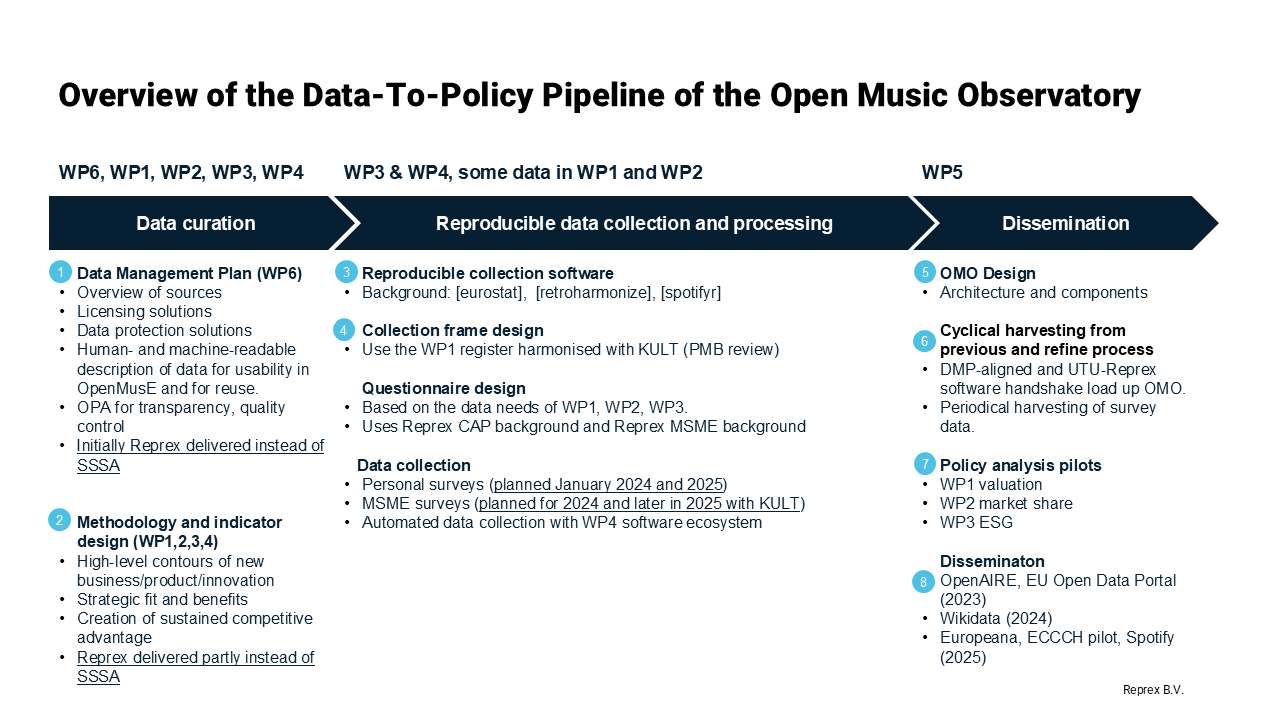
This technical report documents how this process works in practice.
The Background chapter (Chapter 2) explains the conceptual and policy foundations for a decentralised observatory and traces the evolution from CEEMID to the Open Music Observatory.
The Architecture chapter (Chapter 4) describes how the observatory is technically designed—why Wikibase is used, how semantic interoperability is achieved, and how automated ingestion supports the pipeline.
The Data Catalogue (Chapter 10) presents the datasets already curated and ready for ingestion, while the Data Sources chapter (?sec-datasources) explains how administrative, statistical, survey, and platform data were identified and how they align with the Data Management Plan.
The chapters on Data Collection and Processing and on Standardisation describe the software tools delivered in WP4 and the harmonisation schemas that make interoperability possible. Finally, the Dissemination and Dataspace chapters present how the Observatory integrates with Europeana, the EU Open Data Portal, EOSC, ECCCH, and other infrastructures, as well as how national pilots—such as the Slovak Comprehensive Music Database—demonstrate how the Observatory can scale.
Together, these chapters show that the Open Music Observatory is not a static repository but a living, federated infrastructure: one that connects data, metadata, workflows, and policy outputs, and one that can be sustainably expanded by institutions across Europe. This report provides the full technical, methodological, and policy context needed to understand how the Observatory is being built and how it can serve as the basis for a future European Music Observatory.
Following the Executive summary and this introduction (Chapter 1), the report is structured as follows:
Chapter 2 provides an overview of the historical plans for establishing a European music observatory and the rationale for a decentralized approach. It introduces CEEMID—an important precursor to the Open Music Europe project and a key building block identified in the EMO feasibility study. We then conceptualize the Open Music Observatory as a data-sharing space, a technical and legal innovation of the European Union. This section emphasizes compliance with the European Interoperability Framework and the adoption of open collaboration methods, open-source software, and open data as fundamental components. Finally, we review a selection of existing observatories, including those assessed in the EMO feasibility study, to compare their current services with our own.
Chapter 5 explains why the development of the Open Music Observatory requires not only technical tools but also data coordination across institutions, and why such coordination must follow a federated rather than centralised model for music and cultural data. It outlines how distributed governance, subsidiarity, and institutional autonomy shape data practices in Europe, making coordination essential for reliability, comparability, and equitable representation. The chapter introduces the European Interoperability Framework (EIF) as the conceptual backbone for aligning legal, organisational, semantic, and technical layers across diverse actors, and shows how these principles can be extended beyond the public sector to include collective rights organisations, private distributors, memory institutions, statistical offices, and community actors. We believe that a data sharing space is the the practical mechanism for enabling this alignment—distributed infrastructures where actors retain stewardship over their data but interoperate through shared identifiers, semantic mediation, and provenance-aware workflows.
Chapter 3 offers an overview of the current core services of the Observatory, which function as those of a modern statistical vendor and open data portal. In line with the European Interoperability Framework (EIF), we integrate our services into the EU Open Data Portal (as the primary gateway for disseminating statistical datasets), Europeana and the European Cultural Heritage Cloud (for music collections), and the Wikipedia ecosystem (Wikidata and Wikibase) to distribute data into open knowledge graphs.
Chapter 10 introduces our digital curation guidelines and the nucleus of our data offering. Before the release of Observatory 2.0, we could not ingest large, high-value datasets, so the current catalogue contains datasets derived solely from the background IP of the Open Music Europe project. These datasets are already available for testing, and we plan to present the first large-scale datasets and onboarding case studies at several international conferences in November 2025. One such large-scale case study is already underway and will be introduced later in Section 3.1.1.
?sec-datasources revisits the EMO feasibility study and provides an updated overview of data availability and potential partners across the EU. At the time of the feasibility study, many pan-European music organizations pledged to contribute data to a future observatory. We will present the new Open Music Observatory to them, invite them to join the Observatory Stakeholder Network, and request at least sample datasets for publication.
Chapter 8 outlines the data and terminology standardization work initiated by the Open Music Observatory. The feasibility study correctly identified this as a key missing function. We divide the standardization effort into three main areas:
Chapter 9 introduces the “Observatory 3.0” concept, presenting our planned value-added services designed to deliver trustworthy data and leverage trustworthy AI for the benefit of the music sector. We also highlight innovative services that consortium partners are developing using the machine-actionable data our APIs will provide.
The Slovak Comprehensive Music Database SKCMDb https://hudobnadatabaza.sk/ is a national initiative to make Slovak music more accessible, discoverable, and usable across libraries, archives, streaming platforms, and rights organisations. As a functional component of the Observatory, it demonstrates how the dataspace model can integrate public, private, civic, and community data under shared governance. A detailed description is provided in the (see in the Annex).
The Livonian Music Database (LīvMDb) shows that our solution can work wiht music that has low documentation depth, weak institutions. The music of the Livonian people is scattered, and as native speakers of this small ethnic group died out, their heritage was dispersed, and largely not placed on modern digital platforms. The LīvMDb as a functional module of the Open Music Observatory, serves as a testbed for working with very low documentation, decolonisation, and other issues related to regional cultures, ethnic minorities. Its experiences can directly be translated to work with any low documentation depth environment, for example, catalogues of microlabels, self-releasing artists, small publishers. It offers insights into subsidiarity (see in the Annex).
The annexes contain supporting material on the implementation status of the pipeline, the relationships between services and standards, and the governance of the Observatory.
Together, this report and Deliverable 5.1 demonstrate how the Open Music Observatory implements the Grant Agreement’s vision and how it prepares the foundation for a European Music Observatory.