1 Policy context and problem map
The European music ecosystem has undergone disruptive transformations in recent decades. In the 2010s, the arrival of agentic AI in streaming platforms radically reconfigured distribution and consumption. These systems centralised global sales, expanding the commercially available repertoire in a typical EU country from roughly 100,000 titles to over 100 million titles competing for attention. At the same time, the average transaction value collapsed from around €18 (in current prices) to less than €0.005. This shock hollowed out much of the traditional infrastructure — record stores, radios, and music television — and shifted value capture toward data-driven platforms able to control access through recommender algorithms.
In the 2020s, the rise of generative AI further exacerbates this situation. Large-scale models can mass-produce new compositions and recordings, often imitating or plagiarising patterns of human creators. This inflates supply, undermines the position of professional authors and performers, and aggravates existing problems of remuneration and discoverability.1
EU-level studies and policy frameworks have recognised these dynamics and increasingly frame them as systemic challenges. The Feasibility Study for the Establishment of a European Music Observatory diagnosed the fragmented, scarce, and poorly harmonised nature of music data collection across Member States, calling it the fundamental reason for an EU-level observatory. The Music Ecosystem 2025 study reframes the sector as an interconnected ecosystem, where platformisation, market consolidation, and emerging technologies like AI interact with broader societal challenges such as precarity, gender inequality, and sustainability. The European Parliament, in its Resolution on cultural diversity and the conditions for authors in the European music streaming market, echoed these concerns with explicit calls for reform.2
This Green Paper is intentionally accompanied by two implementation-oriented references. First, the annex in Appendix A clarifies how the Open Music Observatory operationalises the recommendations of the CITF First Project Report in a mixed public–private sector, and why we explicitly apply the European Interoperability Framework (EIF) layers (legal, organisational, semantic, technical) and the data sharing space concept when private registers and asymmetric governance are unavoidable. Second, the deliverable Music, Heritage, and Policy in the Age of AI — Building the Diversity Pillar of the European Music Observatory with Federated Knowledge Graphs provides a narrow, worked-through implementation blueprint showing how the policy logic of this Green Paper can be translated into actionable data governance, workflows, and indicators for diversity and circulation, rather than remaining at the level of general recommendations.3
This Green Paper was developed as part of the Open Music Europe Horizon Europe Research and Innovation Action and reflects a deliberate methodological choice: to integrate policy analysis with implementation piloting rather than treating them as separate phases. The project combined research, stakeholder consultation, and hands-on experimentation to test how European music data infrastructures can be built incrementally, under real institutional constraints, and across multiple governance levels.
The Open Music Observatory (OMO) is both a research output and an operational prototype. During the project, the consortium implemented:
a national music data sharing space (the Slovak Comprehensive Music Database), available at https://hudobnadatabaza.sk/en/
a partial national replication in another Member State (Hungary),
a sub-national and cultural-identity–based module (the Finno-Ugric Data Sharing Space), available at https://finnougric.net/en/, which also shows that like the EU Culture Data Hub, it is not practical to work with music as an isolated domain, and
a pan-European core module aggregating datasets, indicators, and studies, available at https://openmusicobservatory.eu/
Together, these pilots demonstrate how a federated, decentralised model can function across supranational, national, regional, and community levels without forcing centralisation. They show how research concepts such as interoperability, provenance, FAIR data, and subsidiarity translate into governance agreements, workflows, and technical interfaces.
This implementation-driven approach responds directly to long-standing European policy calls for a European Music Observatory, including the European Parliament Resolution on Cultural Diversity and the Conditions for Authors in the European Music Streaming Market (P9_TA(2024)0020), and aligns with emerging frameworks such as the European Interoperability Framework, the EU Data Strategy, the European Open Science Cloud, and the European Collaborative Cloud for Cultural Heritage. The Green Paper therefore serves both as a policy synthesis and as a documented reference implementation that can inform future European action.
The European Commission’s feasibility study for the establishment of a European Music Observatory explicitly highlighted CEEMID as a best-practice example of decentralised, open, and reproducible music data integration, recommending that its approach be further explored during the start-up phase of a future Observatory4. The Open Music Observatory can therefore be understood as a direct response to this recommendation, updated to reflect subsequent European data space, copyright infrastructure, and AI policy developments.
Beyond metadata coordination, a key ambition of the Slovak pilot was to address a deeper policy problem: the absence of music-specific economic evidence produced in line with best statistical practice. The pilot was explicitly designed around established methods for business satellite accounts, with the aim of harmonising authoritative collective rights management data with administrative registers, industry datasets, and statistical surveys. This approach sought to generate music-specific statistical indicators that Slovakia’s existing cultural and creative satellite accounting system cannot provide, and which are unavailable in most EU Member States due to the absence of dedicated cultural or creative satellite accounts altogether.
In practical terms, this meant treating rights management data—often the most complete and economically meaningful source of information on music activity—not merely as sectoral metadata, but as a statistical input capable of feeding official economic indicators when properly harmonised and governed. By linking these data sources while preserving methodological transparency, reproducibility, and comparability, the pilot anticipated a model in which music could become visible in official economic statistics without requiring centralised data extraction. Although this experiment was not implemented within the OpenMusE project due to resource constraints and changing institutional conditions, its design remains methodologically sound and operationally feasible, and is directly aligned with current efforts to develop the EU Cultural Data Hub as a foundation for evidence-based cultural policy5.
In line with the European Commission’s Culture Compass for Europe, this Green Paper argues that Europe’s cultural data future must be built on shared, interoperable infrastructures. At the same time, it demonstrates that certain cultural domains — notably music — require specialised, federated implementation layers due to the density of rights, frequency of reuse, and exposure to algorithmic systems. Music therefore provides a strategically valuable reference case for implementing the Culture Compass’s data and AI ambitions in practice.
From the outset of this work, we have taken the view that Europe should avoid building siloed cultural data infrastructures by domain. Wherever possible, cultural data should be shared across domains through common principles, identifiers, and governance frameworks. Domain-specific solutions should emerge only where generic infrastructures reach their limits.
This brings us to a third major contribution to this landscape in the form of the Copyright Infrastructure Task Force, a voluntary cooperation to solve one aspect of the puzzle with willing member states and stakeholders. We see the Copyright Infrastructure Task Force as a possible vechicle to carry on some of our findings, and also a role model to find music’s specialist space in the European cultural infrastracture, including the Cultural Compass, the EU Cultural Data Hub, Europeana and its new data space and the European Collaborative Culture Cloud.
Music is one of the domains where these limits are reached earliest and most visibly, because of its very complex rights management infrastructure, and the extremely high number of events and digital artefacts related to it.
The feasibility study of the Common European Data Space for Cultural Heritage (ECCCH) focuses primarily on digitisation, discovery, preservation, and reuse across cultural heritage domains. This cross-domain orientation is both necessary and appropriate at the foundational level. However, the study does not substantially address music as a domain, nor the specific challenges of music rights, reuse intensity, or lifecycle-driven metadata mutation.
This omission is not accidental, but illustrative: the generic cultural heritage layer cannot realistically encode the sector-specific legal, economic, and technical logic required for music. At this point, neither Europeana or the ECCCH’s first draft ontology can handle music’s copyright rights management and attribution system. Music needs to find its own platform to bring to the cross-domain infrastructure its own data needs.
In 2025 the CITF First Project Report, coordinated by the National Libraries of Finland and Latvia. CITF identifies open identifiers, machine-readable rights metadata, and national libraries as core components of a future copyright infrastructure. It introduces a three-layer model (foundational, semantic, technical) and provides lifecycle analysis of protected works in the AI era. Its findings complement the Music Ecosystem 2025 and EMO feasibility studies by foregrounding the role of cultural heritage institutions and the need for trustworthy, interoperable copyright registries6.
Our policy brief positions itself within this landscape. It aims to support and extend the Music Moves Europe framework by highlighting six crucial dimensions:
- Practical solutions, grounded in dialogue between research and industry, and inspired by concrete experiences with open, federated data-sharing approaches.
- Potential pitfalls where well-meaning initiatives may clash with legacy systems, existing business practices, or contradictions in legislation.
- Legal and operational conflicts, such as the tension between GDPR’s data protection regime and the Berne Convention’s requirement of author attribution.
- Cooperation and workflow sharing, recognising that no single actor can bear the full burden of metadata documentation.
- Technology, including automation, entity recognition, reconciliation, and persistent identifiers.
- AI adaptation and cooperative infrastructures, since most stakeholders cannot attract or retain scarce AI expertise.
By foregrounding these issues, the brief complements the calls of the Music Ecosystem 2025 study and the European Music Observatory feasibility study, while remaining attentive to the practical challenges of implementation across Europe’s diverse music and cultural landscapes.
1.1 Three structural pressures
Three structural pressures frame today’s metadata challenges:
Extreme efficiency pressure. Music is now monetised in micro-transactions worth a fraction of a cent. Each metadata mistake means lost royalties, while big-tech platforms enjoy economies of scale that self-releasing artists, small labels, and national CMOs cannot match. National libraries in many countries already maintain massive copyright-protected collections and identifier systems, which could be cross-utilised with CMOs.
AI-driven disruption. Agentic AI in streaming platforms has already displaced much of the traditional retail and promotion infrastructure. Both pre-deployment and post-deployment of AI affect reproduction, distribution, and attribution rights. Generative AI risks flooding platforms with derivative works and further destabilising discoverability and revenues. Yet AI tools could also support documentation and reconciliation — if governance frameworks can enable them.
Governance and incentive conflicts. Identifiers such as ISWC, ISRC, ISNI, and IPN are essential for attribution and royalty distribution, but are maintained under costly, largely private regimes. Public policy increasingly demands more open metadata, but sustaining investment in these registers remains a challenge. Opt-out rights in AI training and the need for harmonised opt-out registries7, further complicate governance and incentive structures.
These pressures mean that improving metadata is not only a matter of technical interoperability. It is also a question of economic sustainability, legal coherence, and cultural policy. A recent policy paper of Open Future and Europeana made the same diagnosis in a wider, not music domain specific context: heritage institutions are being forced to publish data into AI-driven reuse environments before governance, provenance, and rights frameworks are ready8. The music domain digitised early and has plenty of experience with this increasing problem.
1.2 National and European pilots as anchors
The analytical conclusions of the Study on copyright and new technologies subsequently informed further work at Member State and European levels9, including the establishment of the Copyright Infrastructure Task Force (CITF). The first CITF project report translates the study’s findings into a set of concrete infrastructure-oriented requirements, focusing on interoperable identifiers, standardised metadata schemas, and governance arrangements capable of supporting copyright-relevant data in the digital and AI era10.
In this sense, the CITF process represents a continuation and operationalisation of earlier Commission-initiated analysis rather than a departure from it. The national and European pilots discussed below should be understood within this broader policy trajectory, as practical efforts to test, implement, and refine the types of solutions identified through these preceding analytical and consultative processes.
Several of the implementation pilots referenced in this Green Paper were conducted within formal policy cooperation frameworks rather than as isolated technical experiments. In the Slovak Republic, this work was guided by a Memorandum of Understanding concluded between the Ministry of Culture of the Slovak Republic and members of the OpenMusE consortium11. The Memorandum established a framework for the reuse of open policy analysis outputs in cultural and creative sector policymaking and explicitly supported transparent, evidence-based experimentation with data governance and metadata infrastructures.
This institutional context is significant because it situates the Slovak pilot activities, its replication in Hungary and in the Baltic region within existing public policy processes and legal competences, involving national authorities, collective management organisations, universities, and memory institutions. As a result, the Open Music Observatory (pan-European central module, available at https://openmusicobservatory.eu/), its national federated Slovak Comprehensive Music Database (available at https://hudobnadatabaza.sk/), the national federated Hungarian Music Database, and the music module of the sub-national Finno-Ugric Data Sharing Space (available at https://finnougric.net/) should be seen not only as a technical pilot, but as an example of policy-embedded implementation aligned with both national cultural policy objectives and emerging European discussions on copyright infrastructure.
From the outset, we draw on concrete pilots that illustrate both the problems and possible solutions. Two of them — the Slovak Comprehensive Music Database (SKCMDb) and Unlabel — will recur throughout this paper as reference points. Together, they anchor the three thematic chapters: curation (Chapter 2), the proposed European Music Observatory on the basis of the Open Music Observatory (Chapter 3), and AI (Chapter 4).
1.2.1 The Slovak Comprehensive Music Database (SKCMDb)
SKCMDb is our national pilot for federated metadata governance. It links together data from collective management (SOZA), national and city libraries, and archives, while ensuring that works can also be discovered in the digital environments where people actually listen: Spotify, YouTube, Apple Classical, and others.
A further layer reconciles this metadata with the Slovak Statistical Office via a Satellite Business Register, so that cultural production is visible in official economic data.
The SKCMDb is anchored in the Memorandum of Understanding signed between collective management organisations (SOZA, SLOVGRAM), cultural institutions (Hudobné centrum, Slovak National Library, Hudobný fond), and Reprex. SKCMDb’s strategy of combining copyright data (SOZA), neighbouring rights (SLOVGRAM), and national library authority control directly reflects CITF’s observation that national libraries must be integrated into copyright infrastructure, not treated as purely heritage institutions.
This MoU formalises a federated governance model where:
Attribution (names of authors, performers, composers) is preserved as legally mandatory under copyright law.
Privacy is safeguarded by layered access: public data (names, works, identifiers) circulate broadly, while sensitive data (e.g., addresses, birth dates) remain restricted.
Interoperability is achieved by aligning with VIAF, ISNI, ISWC, ISRC, and Europeana.
As such, the Memorandum provides the legal and institutional foundation for SKCMDb, turning a technical pilot into a national dataspace aligned with the EU Data Strategy.
The SKCMDb in action
The chart illustrates the biography and works of Slovak composer Iris Szeghy as an example:

- Left side: reconciliation of her works across SOZA, the Slovak National Library, the Bratislava City Library, and archives.
- Right side: linking to listening platforms (Spotify, YouTube, Apple Classical).
- Bottom: reconciliation with the Slovak Statistical Office via the Satellite Business Register.
SKCMDb thus acts as a bridge between cultural memory institutions, rights management, digital distribution, and public policy.
SKCMDb provides a pragmatic response to fragmentation and duplication. It anchors the discussion of preventive metadata strategies in Chapter 2.
This challenge is not unique to Slovakia. A recent Horizon Europe policy brief has highlighted how inadequate metadata infrastructures and fragmented European initiatives risk leaving European repertoire dependent on extra-European platforms, AI training datasets, and metadata infrastructures (for example the U.S. Mechanical Licensing Collective and major streaming platforms).12
The diversity dimension of the Open Music Observatory is developed most fully Music, Heritage, and Policy in the Age of AI — Building the Diversity Pillar of the European Music Observatory with Federated Knowledge Graphs DOI: 10.5281/zenodo.1792239013, which operationalises the policy principles and recommendations of this Green Paper into a concrete implementation blueprint, workflows, and indicators, and serves as the primary technical reference for Deliverable D2.3. Unlike many policy analyses that treat diversity primarily as a monitoring objective, the Open Music Observatory Diversity Pillar operationalises diversity as a data governance and infrastructure problem.
Prepared within the Open Music Europe Horizon Europe Research and Innovation Action, it demonstrates how diversity-related policy goals — including cultural diversity, linguistic plurality, regional representation, and the visibility of marginalised repertoires — can be embedded directly into metadata models, identifiers, workflows, and observability rules. Rather than relying on downstream correction or reporting alone, the approach implements diversity by design at the point where data is created, linked, and reused.
The deliverable draws on implemented pilots, including the Slovak Comprehensive Music Database, the Finno-Ugric Data Sharing Space, and cross-border replication experiments, to show how federated infrastructures can support diversity-sensitive indicators without centralisation. It addresses issues such as unequal documentation capacity, under-representation of minority repertoires, language bias in identifiers and authority files, and the amplification of existing inequalities by algorithmic systems.
In policy terms, the document is relevant to current European debates on AI, cultural diversity, as an extension of this Green Paper. It shows how trustworthy, provenance-aware metadata infrastructures can make diversity measurable, actionable, and auditable — rather than symbolic — and how these mechanisms can feed both cultural policy and AI governance frameworks.
Music, Heritage, and Policy in the Age of AI — Building the Diversity Pillar of the European Music Observatory with Federated Knowledge Graphs therefore complements the present Green Paper by providing a fully implemented reference for the diversity pillar, demonstrating how the Open Music Observatory can support European cultural diversity objectives in practice, not only in principle.
1.2.2 Unlabel
If SKCMDb focuses on building preventive infrastructures, Unlabel demonstrates how to repair the past. It is a collaborative pipeline connecting archives, libraries, collective rights organisations, and distributors to bring under-documented repertoires into the global digital supply chain.
A striking example is the case of Hilda Griva, a bilingual Livonian–Estonian artist active in the interwar Finno-Ugric revival. Her recordings were rediscovered in the Latvian Archives of Folklore but lacked the metadata required for circulation. Through Unlabel, we translated and enriched her records, reconciled them with international authorities, and extended them with DDEX catalogue transfer metadata, enabling release via Spotify, YouTube, and Apple Music.
Our multi-layer model (DDEX, DCTERMS, RiC patterns, and rights metadata) aligns with CITF’s three-layer structure: DCTERMS in the foundational layer, RiC and DDEX conceptual mappings in the semantic layer, and DDEX catalogue-transfer formats in the technical layer.
Infobox: Unlabel and Hilda Griva
- Metadata repair began with archival records in the Latvian Archives of Folklore.
- Records were translated, enriched, and reconciled with Wikidata, MusicBrainz, and VIAF.
- DDEX-compliant catalogue transfer metadata enabled digital distribution.
- The enriched catalogue allowed Hilda Griva’s recordings to be released and discovered globally.
Unlabel demonstrates how public heritage institutions and private distributors can cooperate through shared standards. It anchors both the curative AI approaches in Chapter 4 and the observatory perspective in Chapter 3.
1.3 Quest for efficiency
Technological progress, digitisation, automation, and now AI have transformed the music industry more dramatically than most sectors. After the collapse of the CD era under peer-to-peer piracy, a newly configured recording industry emerged around global platforms. Traditional retail and wholesale jobs largely disappeared, replaced by streaming platforms such as YouTube, Apple Music, and Spotify.
This shift coincided with a structural devaluation of music. The licensed streaming model never recovered the real revenues of the pre-collapse recording market, and from this diminished base, platforms take a significant share. Where a CD sale once brought around €10–18 in today’s terms, the unit of account in streaming is a fraction of a cent — typically $0.003–0.005 per play.
To replace the economic weight of a single album sale, a rightsholder must now process and account for roughly 4,000 successful streams. This is not merely an economic shift, but an administrative revolution. The documentation efficiency needed to handle millions of micro-transactions profitably is far higher than in the pre-streaming era.
Streaming platforms are genuine big-data companies. Alphabet’s YouTube, Apple, and Spotify operate at a scale where billions of transactions and hundreds of millions of assets can be managed by autonomous agents and recommender engines. But the typical rightsholder — a self-releasing artist, an independent label, or even a national collective rights agency — works at a scale where each metadata mistake means lost royalties, and where IT or documentation specialists are often absent altogether. This asymmetry is so stark that even major CMOs rely on shared infrastructures like the digital services of “Mint” to manage repertoire at scale.
Music, then, is now sold in extremely low-value transactions mediated by autonomous agents. This reality enforces a very strong pressure on the entire ecosystem to improve data interoperability and metadata quality.
As the CITF report emphasises, AI introduces legal lifecycle pressures: both the training and deployment of AI systems may trigger reproduction, distribution, adaptation, and communication-to-the-public rights. This amplifies the economic consequences of metadata fragmentation: missing or inconsistent identifiers now propagate across algorithmic pipelines as well as financial ones14.
By contrast, in most industries administrative overhead is modest:
- Retail/distribution: ~2–5% of net sales
- Manufacturing: ~3–7%
- Professional services: 10–15% (because administration blurs into the product)
- OECD/EU cross-industry averages: 3–8% of turnover
In “normal” industries, then, €50 of administrative cost is justified on €1000 of revenue. By comparison, in the recorded music industry, achieving that same 5% efficiency requires delivering faultlessly some 200,000 streaming transactions. This is a very tall order for a sector dominated by micro-enterprises and small independents without dedicated IT or metadata teams.
The pressure for efficiency is not only present on the production side of the music business. In the non-profit sector, digitisation has profoundly transformed the workflows of archives, libraries, and heritage institutions as well. Streaming has reduced demand for physical collections, forcing libraries to reframe their role around digitisation, knowledge organisation, and community functions rather than lending CDs or scores. New spaces like creative studios and digital repositories are expected, but funding is limited, so efficiency is critical. At the same time, the vast amount of born-digital assets — and now the endless output of generative AI systems — creates a puzzle for archives that remains unsolved today.15
Metadata as provenance
In today’s music ecosystem, almost every asset is born digital. A modern composer’s score is produced in notation software; a performer’s recording originates as a digital file; even printing, distribution, and promotion leave their own digital traces. From the very start, each musical work and each recording comes with a dense digital fingerprint.
As these works move through their lifecycle — composition, registration, performance, recording, distribution, preservation — they accumulate provenance statements: “X composed this,” “Y registered that,” “Z archived this file.” Taken together, these traces form a chain of knowledge about the history of the work. Unlike in earlier centuries, this history is now almost continuously captured, though often fragmented or messy — the “shadows” that Karabinos has described.
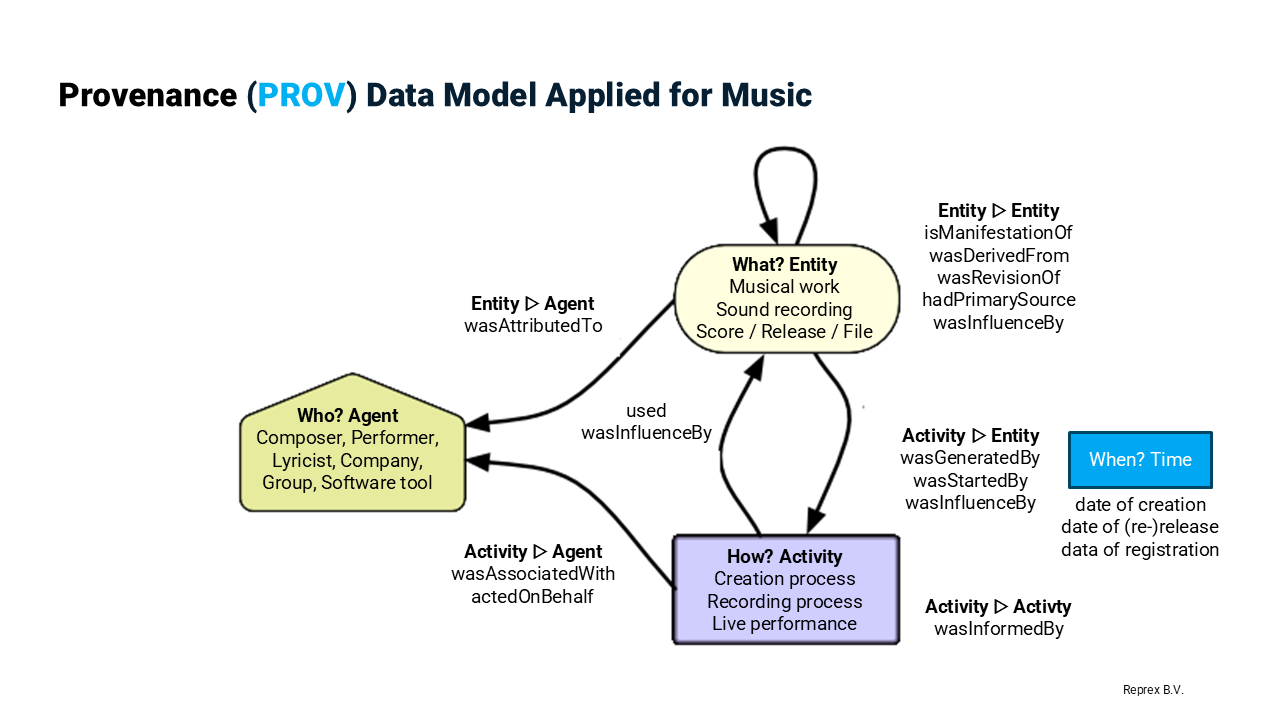
Metadata is “data about data.” But in practice, what counts as data or metadata is relative: a duration may be descriptive for one actor, identifying for another, and algorithmic input for a third. This distributed record of provenance resembles a chain of statements, some verifiable, some contradictory, some lost in the shadows. The challenge is not to build a single immutable blockchain, but to make the distributed record reliable, reusable, and interoperable.
As shown in Section 1.2, pilots like SKCMDb and Unlabel provide two complementary responses: preventive governance of metadata at creation (Chapter 2), and curative repair of legacy repertoires (Chapter 4; Chapter 3).
The earlier introduced Open Future and Europeana policy brief on the publication of cultural heritage data in the age of artificial intelligence highlights why provenance failures can no longer be treated as a tolerable archival imperfection. When incomplete, ambiguous, or degraded provenance metadata is incorporated into automated and AI-driven systems, those systems tend to treat it as authoritative, propagating errors, omissions, and misattributions at scale rather than correcting them. In this context, broken provenance is not merely a documentation problem but a structural risk: once embedded in algorithmic pipelines, it shapes discovery, attribution, reuse, and economic outcomes in ways that are difficult to reverse. This reinforces the need for lifecycle-aware metadata governance that treats provenance as a core infrastructural concern in the AI era, rather than as a secondary administrative afterthought.
1.4 Potential solutions
The challenges described above call for coordinated responses that combine technical, organisational, regulatory, and governance measures. This policy brief develops them in detail across three thematic chapters — curation (Chapter 2), the observatory (Chapter 3), and AI (Chapter 4). Here we present an integrated overview of the solution families.
Reducing redundancy and improving efficiency.
Shared registries and federated pipelines ensure that data is captured once and reused many times. The Slovak Comprehensive Music Database (SKCMDb, Chapter 2) demonstrates how libraries, rights societies, and archives can align their catalogues while retaining institutional autonomy.Reconciling attribution and privacy.
Metadata must balance GDPR requirements with author attribution duties under copyright law. Identifier pilots such as PRS Nexus and Teosto ISNI show preventive strategies at the point of creation, while SKCMDb offers curative repair of legacy repertoires.Pragmatic metadata alignment.
Instead of one universal ontology, modular and pattern-based approaches allow interoperability across domains. Initiatives such as Polifonia, MusicBase, and the Unlabel pipeline provide practical bridges between archival, library, and distribution metadata (Chapter 2, Chapter 3).Cross-sector observatories and data spaces.
The Open Music Observatory (Chapter 3) applies the European Interoperability Framework and 8-Star FAIR model to connect rights societies, libraries, archives, and statistical offices. Data sharing spaces provide governance, semantic, and technical layers that make public and private infrastructures interoperable.Curative strategies with AI.
Many repertoires remain invisible due to incomplete or inconsistent documentation. Curative AI (Chapter 4) can support enrichment, translation, duplicate detection, and plagiarism monitoring, extending the principles of Unlabel to broader repertoires.Bridges to public infrastructures.
Europe already invests in the European Open Science Cloud (EOSC), the European Collaborative Cloud for Cultural Heritage (ECCCH), and Europeana. These infrastructures should be aligned with the music sector to support both cultural preservation and competitive participation in digital markets.Shared AI services.
Micro-enterprises, NGOs, and CMOs cannot build in-house AI capacity. Cooperative AI utilities — reconciliation-as-a-service, metadata repair pipelines, watchlists for duplicates — can be pooled under shared governance (Chapter 4).
This integrated roadmap frames the more detailed analysis and recommendations in the chapters that follow.
The analysis and examples presented in this Green Paper are informed by a set of closely related analytical, legal, and implementation documents, including:
Study on copyright and new technologies: copyright data management and artificial intelligence
Interoperable, trustworthy, and machine-readable copyright data in the AI era (CITF First Project Report)
Memorandum of Understanding on the reuse of Open Policy Analysis outputs in Slovak cultural policy
OpenMusE technical deliverables documenting implemented data infrastructures and workflows
These materials provide additional detail on the legal, technical, and institutional assumptions underlying the policy synthesis offered here.
The CITF report, based on the Study on copyright and new technologies: copyright data management and artificial intelligence, defines a structured approach to future copyright infrastructures through three layers (foundational, semantic, technical). The solution pathways proposed in this Green Paper can be mapped onto these layers: identifier governance corresponds to the foundational layer; pragmatic ontology patterns map to the semantic layer; and federated pipelines align with the technical layer. See for further details the Appendix A in the Annex.
Music Ecosystem 2025: Study on the Music Ecosystem (Music Moves Europe 2024); it frames the sector as an adaptive, networked ecosystem, highlights AI’s ability to disrupt on pp. 6–7, and mentions it as an opportunity particularly on p. 23. Feasibility Study for the Establishment of a European Music Observatory (Commission et al. 2020); stresses the fragmented, scarce, and poorly harmonised nature of music data (pp. 9–10), the need for cooperation with rights organisations, statistical agencies, and industry stakeholders (p. 61), and introduces CEEMID as a best practice (pp. 147–148). CEEMID emerged from Budapest, Bratislava, and Zagreb as an early effort to address data poverty in Eastern EU Member States.↩︎
European Parliament Resolution on cultural diversity and the conditions for authors in the European music streaming market (European Parliament 2024); it recognises streaming as the dominant global revenue source while leaving many authors with very low income (recitals F–H), stresses accurate metadata allocation at the time of creation using identifiers ISWC, ISRC, ISNI, IPI, and IPN (recital R, and 9.), highlights the lack of quality data to properly identify authors, performers, and rights holders (recital L), and warns that AI-generated tracks are flooding streaming platforms, aggravating discoverability and remuneration imbalances (recital O).↩︎
The CITF alignment annex is included in this Green Paper as an unnumbered section (“CITF”). The diversity-and-circulation implementation blueprint is Music, Heritage, and Policy in the Age of AI — Building the Diversity Pillar of the European Music Observatory with Federated Knowledge Graphs (Antal 2025) (Deliverable D2.3 / D21 draft).↩︎
Measuring and Reporting Regional Economic Value Added, National Income and Employment by the Music Industry in a Creative Industries Perspective. Memorandum of Understanding to Create a Regional Music Database to Support Professional National Reporting, Economic Valuation and a Regional Music Study (Artisjus et al. 2014) and Central And Eastern European Music Industry Report (2020) (Antal 2020).↩︎
Pilot Program for Novel Music Industry Statistical Indicators in the Slovak Republic (Antal 2023). The pilot was not implemented within the OpenMusE project due to resource constraints and institutional changes, but its methodological design remains valid and suitable for continuation in the context of EU Cultural Data Hub preparatory work.↩︎
Interoperable, trustworthy, and machine-readable copyright data in the AI era. Report of the CITF First Project (Partanen et al. 2025)↩︎
As emphasised by CITF on pp. 17, 23–24 (Partanen et al. 2025, p17, pp. 23-25).↩︎
Publishing Cultural Heritage Data in the Age of AI (Keller 2025)↩︎
Study on copyright and new technologies: copyright data management and artificial intelligence (SMART 2019/0038) (European Commission et al. 2022)↩︎
Interoperable, Trustworthy, and Machine-Readable Copyright Data in the AI Era: Report of the CITF First Project(Partanen et al. 2025)↩︎
Memorandum o porozumení o využití výsledkov analýz otvorených politík v kontexte slovenského kultúrneho a kreatívneho priemyslu a sektorových verejných politík v spolupráci s konzorciom pre výskum a inovácie s názvom OpenMuse. [Memorandum of Understanding on utilizing the Open Policy Analysis results of the OpenMuse Research and Innovation Consortium in the context of Slovak cultural and creative industries and sectors’ public policies](Ministerstvo kultúry SR and Open Music Europe 2023)↩︎
See Policy Brief 1: Music Metadata Mainstreaming and EU Law (Senftleben et al. 2024) (Deliverable D5.6, OpenMusE project). That brief emphasises that without a European metadata infrastructure, EU repertoires may remain underexploited and culturally invisible, while foreign platforms consolidate hegemony. The present Green Paper extends on this line of argument by focusing on lifecycle-based interoperability and federated observatories as safeguards for European sovereignty.The Policy Brief 1 Annex references the Slovak Listen Local / SKCMDb project as a national pilot, underlining its relevance for EU-level policy design. The Green Paper complements this by situating the MoU as a replicable governance framework for federated metadata spaces.↩︎
Music, Heritage, and Policy in the Age of AI (Antal 2025)↩︎
See (Partanen et al. 2025, p31).↩︎
See for example the Katona József Library’s adaptive strategies (Virág 2024). Archives, on the other hand, face a problem that instead of receiving records on paper, they are becoming gigantic data silos in the age of born-digital documents. They are being transformed into data through digitisation and born-digital records, face volumes too large for manual processing. This pressures traditional archival concepts such as provenance, original order, fixity, and authenticity (Colavizza et al. 2022).↩︎